
Introduction
The modern cuisine of the Northeast US developed after the onset of Western industrial abundance; refrigeration, cane sugar, and cheap trade arrived before regional constraints shaped a distinctive and coherent food culture. There was, of course, a cuisine before colonization; rather, there were many cuisines. For thousands of years — both before and after agriculture — the Indigenous inhabitants of the Northeast cooked under constraints we may consider generative: long winters, seasonal gluts, little or no salt, and no refrigeration. Our written sources on these cuisines are sparse and largely produced by outsiders, often long after the fact. But, from a careful reading of these sources, alongside archaeology and testimony from extant Indigenous Northeastern communities, we can construct a coherent — albeit fragmented — picture of how these cuisines likely functioned.
To define the scope: Indigenous Northeast food spans many distinct historical communities. On the northern coast, there were the Wabanaki nations; the Wampanoag, Narragansett, and their neighbors in southern New England; the Lenape along the Delaware and the lower Hudson; the Haudenosaunee (Iroquois) nations across New York; and just north of the region, in present-day Canada (Ontario), the Wendat (Huron), whose food culture happens to be particularly well-documented. Our reconstruction utilizes observations from colonists written in English, Dutch, and French — though these accounts are often disdainful of those cultures about which they wrote — from early-twentieth-century ethnographers, from archaeologists, and modern Indigenous communities.
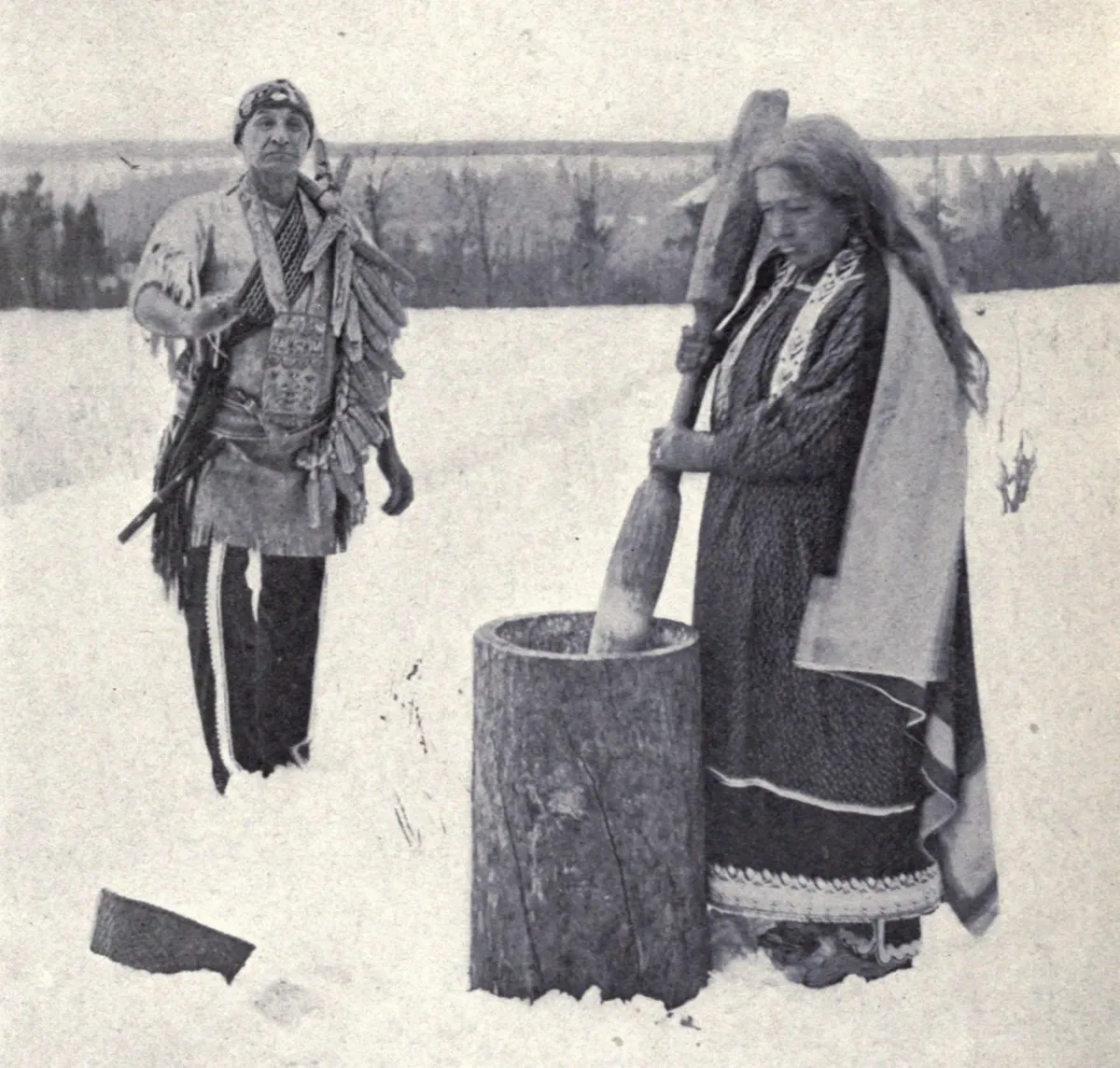 Feast makers at the Seneca midwinter festival in New York, February 1909, pounding corn in a wooden mortar. Photograph from Arthur C. Parker, Iroquois Uses of Maize and Other Food Plants (1910), plate 12.
The Indigenous Landscape Before Colonization
At the mouth of the Saco River in 1605, French explorer Samuel de Champlain found beans, corn, and squash co-planted in hills; they grew into one another, with beans climbing the cornstalks. He also discovered storage practices: corn preserved for the winter in grass sacks buried in trenches of sand.1 This “Three Sisters” planting orientation is a commonly understood story of Indigenous agriculture, but archaeobotanical remains illustrate a somewhat more complex one. Along the Upper Delaware Valley, remains have been discovered of sunflower, chenopodium (a quinoa relative), and marshelder2, a daisy-family plant grown for its oily seed. Field fertility appears to have been carefully maintained.3 Colonists described Indigenous people burying fish in corn mounds as fertilizer, though some historians question whether the practice predates European contact.4
Food migrated with the season, and people migrated with the food. Spring ushered in fish: shad and alewife, a species of river herring, which ran up the rivers in large numbers. Lenape people took advantage of the abundance by gathering in larger numbers at riverside fishing camps.5 Coastal communities went shore-ward for lobster and other shellfish. The Plymouth English describe that in summer, the Indigenous people lived “where victual is easiest to be got.”6 Summer brought berries and green corn. In fall, there was harvest. Nuts and other produce were dried and stored. In winter, stores were depleted and coastal communities moved inland to hunt.5 The Seneca ethnographer Arthur C. Parker writes that Iroquois households before and just after contact had one regular meal a day, cooked in the morning, and the pot then stayed warm for anyone who was hungry.7
Communities were not isolated. Food became a medium of exchange, both among Native nations and with colonists. Roger Williams, who wrote a phrasebook of the Narragansett language in 1643, recorded trading of corn, skins, venison, and fish, in addition to craft goods like bows and dishes.8 As a result, storage became both a seasonal necessity and a foray into the economic. The Wendat grew two or three years’ worth of corn, both as insurance for their own use and for trade.9 Europeans immediately adopted maize; in 1628, the Plymouth colonists shipped corn surplus north to trade for beaver, even circulating wampum beads, a local currency made from purple-hued quahog shells.10 Some food items became adopted by Europeans, and are better preserved as such; nokehick became “nocake,” msickquatash became “succotash,” and nasaump, a corn porridge, became the “samp” that the colonial governor John Winthrop Jr. called “the most common diet of the planters” in New England’s first years.811 Though many items of this pre-colonial cuisine have become lost, some have survived and permuted through European — now American — adoption.
The Indigenous Larder
Indigenous Northeast US cuisine, like all cuisines — we argue — is composed of a shared lexicon of ingredients, techniques, and form.
Let’s examine what we know of each.
The Pantry
Like rice for many Asian cuisines, corn was undoubtedly the staple of Indigenous Northeastern cuisine. Also like rice, it took many varied forms: as a starch, as a vegetable, as a flour, as a snack, and so on.
Green, “milk-stage” corn was sweet enough to be roasted and eaten from the cob, or boiled, dried, and stored. Winthrop’s informants called it pondomenast, and it was, he wrote, “a principall Dish” both at daily meals and occasional feasts11; like larder items in many cuisines, corn spans the gamut of social and economic contexts. Mature corn — now dry and starchy — was treated with lye to break down its hulls, cracked, pounded, or desiccated completely. Corn of all colors was used: purple and calico by the Seneca, yellow corn by the Wampanoag on Martha’s Vineyard.1213 It was often served with beans and squash; the squash was sliced into rings, hung, and dried.14
Storage was an important part of Indigenous cuisine. A well-stocked larder may have consisted of the following, though likely more, depending on time, place, and culture:
- Parched corn meal (nocake), which was eaten dried or stirred into water as a mash.1115
- Dried green corn.1112
- Dried squash rings, dried berries, and dried chestnuts, which were stored through the year.814
- Nut oils and sunflower oil along with bear fat, which was rendered and stored in bags made from animal skin.1214
- Maple syrup or maple sugar, sometimes poured into empty eggshells from ducks and quails.12
- Dried and smoked fish, hung over the fire, sturgeon and shad, along with herring dried without salt.56
Dishes, as is true in most traditional food cultures, revolved around starch with occasional inclusion of fish or meat. Starch was most oftentimes corn, assisted by beans or squash.15 Oftentimes, fat was added to enrich the dish at the end; the Wendat may have poured oil or melted fat over soup before serving, while the Seneca spread animal fat — deer or bear oil — on slices of corn-based bread.912 Sweetness was the work of maple, green corn, and berries. For acidity, sometimes maple sap would be turned into vinegar, a “highly esteemed” product for the Seneca.12 The natural acidity of sumac lent itself to a drink, along with aromatics.16 Funk, we’ll discuss below.
Surprisingly, salt seems to have been largely absent. European visitors noticed that the Northeast Indigenous communities ate very little salt; even as late as 1916, some Iroquois traditional dishes were made completely absent of salt.16 Savoriness and salinity may have come from elsewhere. As described by Roger Williams, the Narragansett cooks boiled clams and used their natural liquor to season soup bases and bread.8 The ash of wood and corncobs was also used as a seasoning.1216
Drinks were varied, though water alone — at least for the Wendat — was the primary drink.916 The starch-laden water left over from boiling corn was drunk as a treat.12 Crushed hickory nuts were boiled in water to make a sort of nut-milk.1216 Maple sap was drunk fresh as a lightly sweet beverage, and berries were steeped in water sweetened with maple sugar. Teas and aromatics were diverse and variable, including black birch, sassafras, spicebush, hemlock, monarda, and wintergreen. Some were drunk with meals.16 Fermented drinks seem to have been rare, in contrast with many other grain-based cuisines, and grapes, despite their prominence as a wild species, were not fermented.16
The Art
To a cuisine, ingredients are as a lexicon, and techniques as a grammar. Here are some of the various recorded techniques of the Indigenous Northeast kitchen:
To hull corn, cooks would boil it with lye, a cousin process of Mesoamerican nixtamalization, which is used to make masa as in tortillas. Lye loosens the hulls and breaks them down enough to slip off, leaving a kernel that is easier to eat and digest.1216 The ability for the corn to absorb water during cooking and for its starches to gelatinize also increases under these conditions. Sometimes, acorns were treated in the same way to increase digestibility and remove their tannic bitterness.12
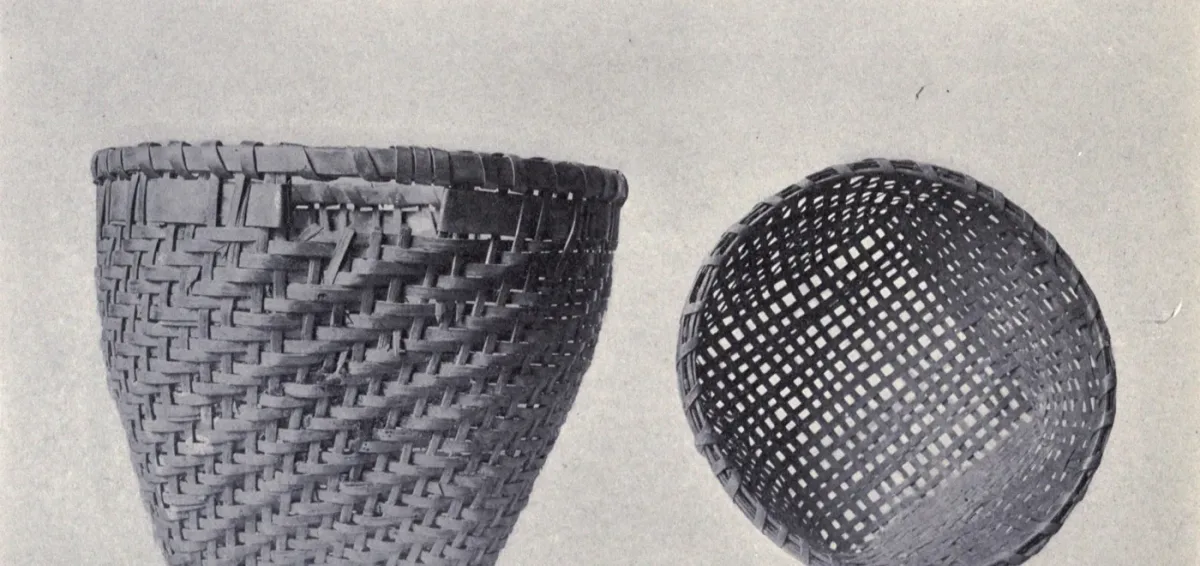 Seneca hulling and hominy baskets, used to rinse the loosened hulls from lye-boiled corn and to sift cracked hominy. Parker (1910), plate 13.
Parching, or dry-roasting, was used to prepare corn, which was then often pounded and sifted. The Wendat parched corn in ash and sand, then pounded it and winnowed off the fine flour using a fan made of bark.911
Boiling was, as is true for many traditional cuisines, a default technique. Even bread was sometimes boiled; the Seneca would mix cornmeal with boiling water, which pre-gelatinized the starch, giving it additional structure (of course, without any gluten); then, they were shaped into loaves and simmered until floating.12 Wendat corn soup was highly variable: thick and thin, coarse and fine. The missionary Gabriel Sagard noted that the Wendat were as particular about their corn soups as the French were about their sauces.9
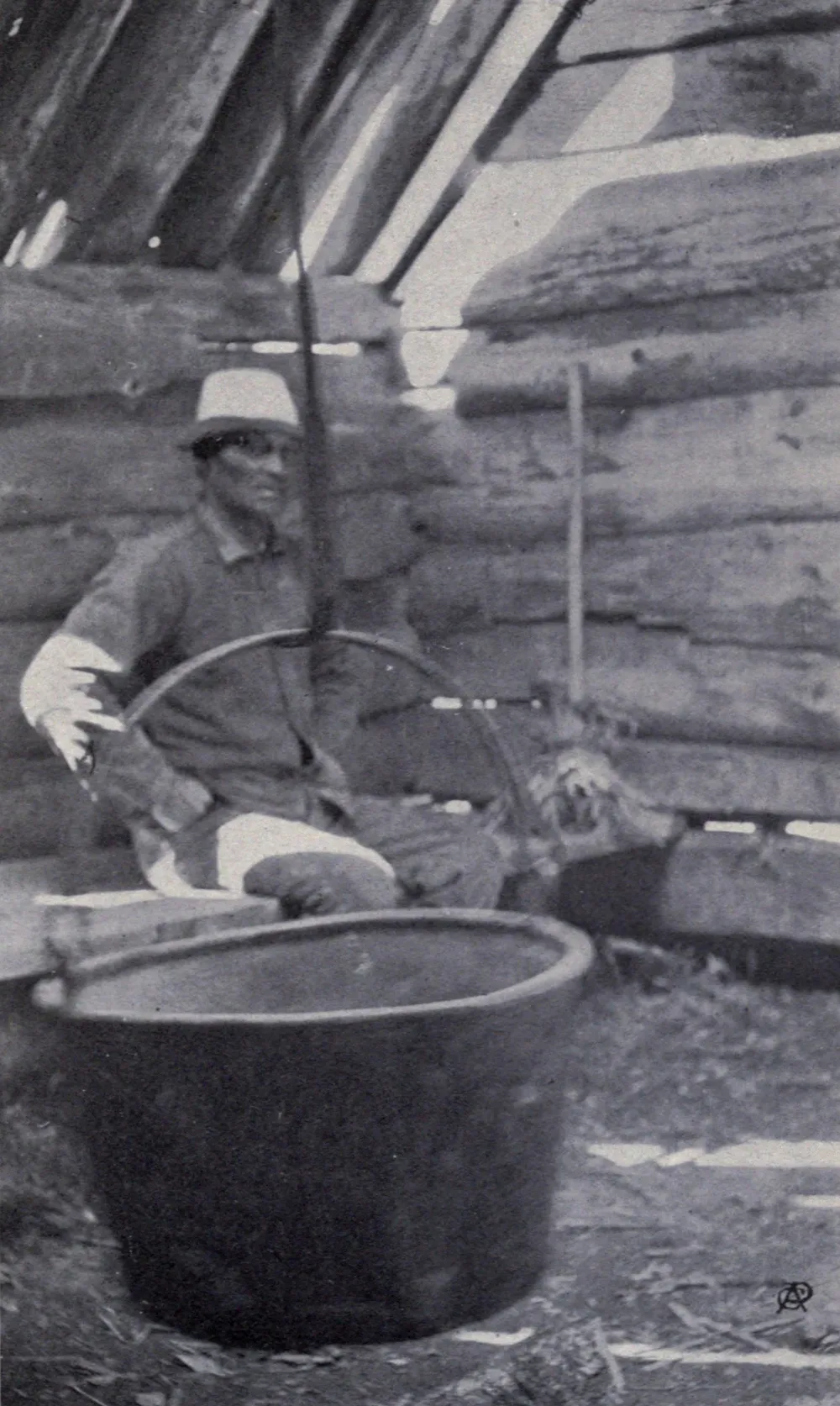 Interior of the Seneca ceremonial cookhouse at Grand River, Ontario, with a large brass kettle: by the twentieth century, trade metal had long replaced clay for the communal soup pot. Photograph by Parker (1910), plate 10.
Sometimes, these breads were instead baked in ash, another recurring technique. Oftentimes, these were baked unwrapped or wrapped in leaves. Parker proposes hoe cakes and johnny cakes as their descendants in more modern cookery.12
Drying was an important part of the repertoire of Indigenous preservation techniques. Fish, corn, squash, berries, meat, and nuts were all dried, sometimes under the sun, sometimes by the fire. Smoke was sometimes deliberate and sometimes incidental. The Seneca deliberately smoked meat over smothered, smoldering corn cobs, limiting flame and heat.12
Fermentation played a proportionally small role, as far as we can tell, in Indigenous Northeastern cuisine; though sparse, where it appears, these dishes were highly desired. For feasts, the Wendat made a dish called leindohy (“stinking corn”); ears of corn were picked green, left in water — oftentimes a pond — for a few months, then boiled or roasted. Sagard notes that while his European palate found the smell unbearable, the Wendat sucked the ears “as if they were sugar cane.”912 Though not strictly a ferment, the Wendat also made a bread — which was highly prized — from unripe corn; first, it was chewed, then pounded, then baked. Similar to the South American chicha, the amylase enzymes in the saliva break the starches in the corn into sugars, which would have made the final bread sweeter.9 And of course, sugary liquids like maple sap were sometimes left to ferment into vinegar.1216
Tapping maple trees for sap is deserving of a much longer explanation, but I’ll provide a short one here. First, a slanted cut in the maple trunk was made, into which a spout was stuck to guide the sap into a tub made of bark.12 While what came next before contact is debated, some early French writers noted that the Indigenous people did not boil down the sap into sugar until shown by the Europeans; others insist the opposite.1617 The process of tapping and the maple tree itself were honored in ceremony.12
The Kitchen
Technique shaped the tools of the Indigenous kitchen, and the tools shaped technique.
The wooden mortar and pestle was essential for pounding corn for porridge and flour.1213 The sieve — oftentimes a series of woven baskets of various porosity — allowed the sifting of flours into finer and finer forms. Coarse grains could then be added back to the mortar to be pounded into finer flour.12 Clay pots were set directly on the fire for boiling; peoples without pottery boiled food in bark or wooden vessels by dropping in red-hot stones.918 Fire pits doubled as ovens: heated, loaded with corn, squash or roots, and covered in ashes to bake in the pit’s residual heat.1218 Sometimes, items like fish were wrapped in clay and baked directly in the hot ashes.14 Bark barrels, woven sacks, and baskets were used for storing dried and preserved items, or sometimes pits lined with hemlock boughs and dried grass.618
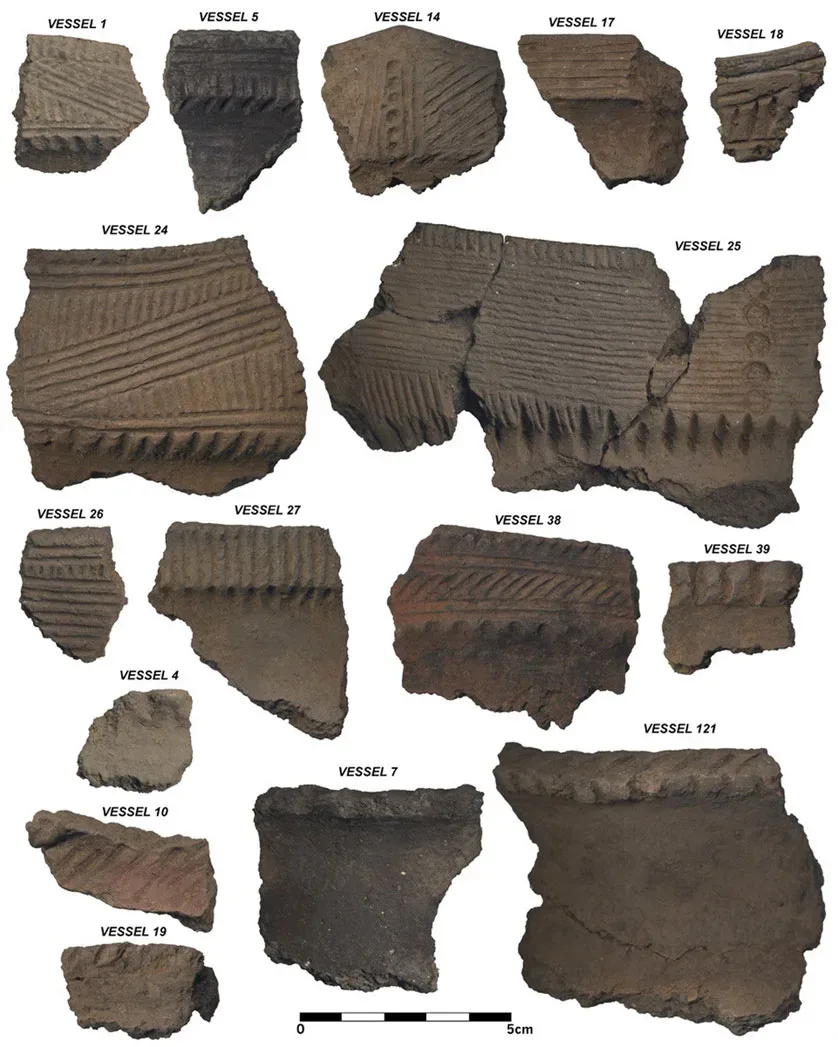 Rim sherds from fifteenth- and sixteenth-century Iroquoian cooking pots at the Dawson site in present-day Montreal, selected for residue analysis that found traces of maize and fish cooked together. From Karine Taché et al., “Farmers with a Taste for Fish,” American Antiquity (2025), fig. 2 (CC BY 4.0).
The Indigenous and Modern Northeasts
Our records of Indigenous cuisine — though sparse — show the ability of a cuisine to adapt to constraints, oftentimes toward the end of great deliciousness. A cuisine without significant amounts of salt developed new methods to create savoriness. One that couldn’t readily store liquids, dried foods for preservation and travel. One around a single grain — corn — turned it into dozens of forms and functions. And the cooking technology itself, and the restrictions of its use, informed the development of food culture.
The landscape of the Northeast US has since changed significantly. Roughly 31 percent of New England’s plant species are non-native, and a fraction of those are invasive.19 It’s somewhat futile to attempt to re-native the entirety of the region, though we can borrow from the techniques, ingredients, and recipes that survive of these Indigenous communities. Now we are faced with a fascinating challenge: to create restrictions for ourselves that allow us to find novel, innovative, and delicious uses for these modern ingredients — naturalized, invasive, and waste streams — just as the Indigenous people of the Northeast found so many uses for corn.
Bibliography
Footnotes
-
Samuel de Champlain, Voyages of Samuel de Champlain, 1604–1618, account of 1605, bk. I, ch. 8, pp. 62–63, 71–72, Internet Archive. ↩
-
Justin M. Reamer, “Evidence for the Eastern Agricultural Complex Crops in the Upper Delaware Valley: Botanical Analysis from the Manna Site (36PI4),” American Antiquity, 2024, pp. 516–524, DOI. Archaeological presence does not by itself show whether each plant was cultivated, gathered, or traded. ↩
-
John P. Hart and Susan Winchell-Sweeney, “Resetting Archaeological Interpretations of Precontact Indigenous Agriculture: Maize Isotopic Evidence from Three Ancestral Mohawk Iroquoian Villages,” American Antiquity 88, no. 4 (2023): 497–512, DOI. The study measures field fertility; the management practices behind it are inferred, not observed. ↩
-
John Winthrop Jr., “Indian Corne” (1662), published as “John Winthrop, Jr., on Indian Corn,” intro. Fulmer Mood, New England Quarterly 10, no. 1 (1937), pp. 126–129, Project Gutenberg; Isaack de Rasieres, letter of 1628, in J. Franklin Jameson, ed., Narratives of New Netherland, 1609–1664 (1909), p. 111, Internet Archive; Lynn Ceci, “Fish Fertilizer: A Native North American Practice?” Science 188, no. 4183 (1975): 26–30. ↩
-
Delaware Tribe of Indians, Lenape Fishing, pp. 1–2, with illustrations by Herbert C. and John T. Kraft. See also Maine Indian Tribal-State Commission, Sea Run, pp. 30–31, on Wabanaki seasonal movement. ↩ ↩2 ↩3
-
Mourt’s Relation: A Journal of the Pilgrims at Plymouth (1622), Project Gutenberg. See also Thomas Morton, New English Canaan (1637), pp. 225–226, Internet Archive, on dried lobster. ↩ ↩2 ↩3
-
Arthur C. Parker, Iroquois Uses of Maize and Other Food Plants, New York State Museum Bulletin 144 (1910), pp. 61–62, Biodiversity Heritage Library. ↩
-
Roger Williams, A Key into the Language of America (1643), chs. II, XVI, XIX, and XXV, Internet Archive. ↩ ↩2 ↩3 ↩4
-
Gabriel Sagard, Le Grand voyage du pays des Hurons (1632), Part I, ch. 8, pp. 133–143, Wikisource. Translations in the text are our own paraphrases. Sagard lived among the Wendat in 1623–24. ↩ ↩2 ↩3 ↩4 ↩5 ↩6 ↩7 ↩8
-
De Rasieres, in Jameson, Narratives of New Netherland, pp. 106, 113. ↩
-
Parker, Iroquois Uses of Maize: mortars, sieves, and utensils, pp. 46–56; pit ovens, pp. 60–61; boiled and ash-baked bread, pp. 69–71; dried corn, p. 74; leindohy, p. 79; cob smoking, p. 86; nuts, acorns, and oils, pp. 99–102; maple, pp. 102–104. ↩ ↩2 ↩3 ↩4 ↩5 ↩6 ↩7 ↩8 ↩9 ↩10 ↩11 ↩12 ↩13 ↩14 ↩15 ↩16 ↩17 ↩18 ↩19 ↩20 ↩21
-
Gladys Tantaquidgeon, “Notes on the Gay Head Indians of Massachusetts,” Indian Notes 7, no. 1 (1930), pp. 4–9, Internet Archive. ↩ ↩2
-
Delaware Tribe of Indians, Foods Eaten by the Lenape Indians, pp. 1–2. ↩ ↩2 ↩3 ↩4
-
Daniel Gookin, Historical Collections of the Indians in New England (1674), ch. III, §§5–6, pp. 150–151, in Collections of the Massachusetts Historical Society, vol. 1 (1792), Internet Archive. ↩ ↩2
-
F. W. Waugh, Iroquis Foods and Food Preparation, Canada Department of Mines Memoir 86 (1916): hulling, p. 62; maple, pp. 140–142; beverages, pp. 144–150; salt, pp. 150–152, Internet Archive. Waugh compiles earlier observers, including Cartier, Loskiel, Lafitau, Charlevoix, and the Jesuit Relations. ↩ ↩2 ↩3 ↩4 ↩5 ↩6 ↩7 ↩8 ↩9 ↩10
-
Deborah Jean Warner, Sweet Stuff: An American History of Sweeteners from Sugar to Sucralose (Smithsonian Institution Scholarly Press, 2011), pp. 160–161. ↩
-
Waugh, Iroquis Foods, pp. 42–44 (storage pits), 55–56 (bark kettles, stone boiling, and pit ovens). ↩ ↩2 ↩3
-
New England Wild Flower Society (now Native Plant Trust), State of the Plants: Challenges and Opportunities for Conserving New England’s Native Flora (2015), p. 11, citing L. J. Mehrhoff, “Immigration and Expansion of the New England Flora,” Rhodora 102 (2000): 280–298. The figure is the share of plant taxa (species and varieties) in the New England flora that are non-native, meaning introduced since 1500; 111 of those, about 3 percent of the whole flora, are listed as invasive or potentially invasive. ↩